
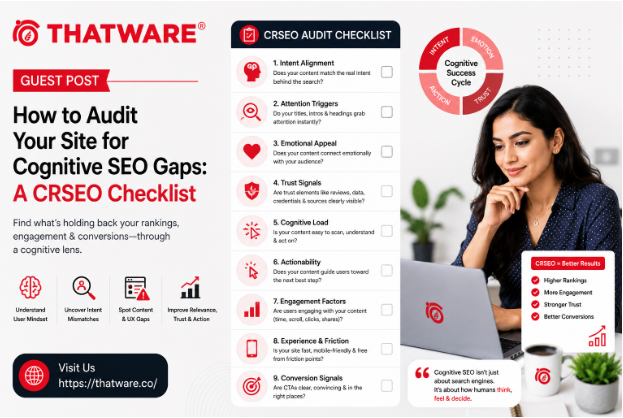
Most SEO audits look at the same things: technical crawlability, page speed, backlink profile, keyword rankings, content gaps. These are important diagnostics. But they tell you almost nothing about the psychological experience of a human being navigating your site.
A CRSEO audit fills that gap — systematically identifying where your site creates psychological friction, mismatches between expectation and reality, or missed opportunities to build trust at the moments that matter most.
Here’s how to run one.
Section 1: Emotional Continuity Audit
Start by mapping the emotional journey of your primary user personas from their most common search queries to your most important conversion pages.
For each key landing page, ask: what emotional state is a visitor in when they arrive from the most common search query that drives traffic to this page? Now look at the first viewport of that page. Does the tone, the imagery, the headline, and the opening copy match that emotional state — or contradict it?
CRSEO audit services typically find significant emotional discontinuities on a majority of audited pages. A page about tax preparation that gets traffic from anxious first-time filers and opens with “comprehensive solutions for all your accounting needs” is creating immediate emotional distance.
Document every mismatch. These become your highest-priority optimization targets.
Section 2: Cognitive Load Assessment
For each key page, conduct a cognitive load assessment. The goal is to identify every element that requires unnecessary mental effort.
Questions to ask: Is the main message of this page immediately obvious from the heading structure alone? Are there competing calls to action that require the visitor to make a choice before understanding the value? Is any jargon used that the target audience would need to decode? Are there sections that could be simplified without losing essential information?
Cognitive load audits are best done by someone outside the organization — someone who hasn’t spent months looking at the same pages and can still experience the cognitive friction that familiarity has hidden from the internal team.
Cognitive SEO services bring this outside perspective as a professional discipline, with frameworks for measuring and scoring cognitive load that go beyond subjective impression.
Section 3: Trust Signal Positioning Review
Map every trust signal on each page — testimonials, certifications, guarantees, case studies, awards, review scores. Now evaluate three things about each: Is it positioned near the point of maximum anxiety? Is it specific enough to be credible? Is it in the format most appropriate for this audience at this stage of their journey?
Most sites have adequate trust signals but position them poorly — typically at the bottom of pages, after the visitor has already experienced their peak anxiety moment and either converted or left.
Section 4: Conversion Psychology Gap Analysis
For each conversion point on the site, identify the primary psychological objection that prevents conversion — the one fear, uncertainty, or hesitation that is causing visitors to not take action.
Then look at the content immediately preceding that conversion point. Does it directly address that objection? If not, that’s a gap.
These gaps are often the highest-leverage optimization opportunities in the entire audit — because they’re closest to the money.